Meet Kling O1: How the First "Unified" Model Brings Reasoning to Video
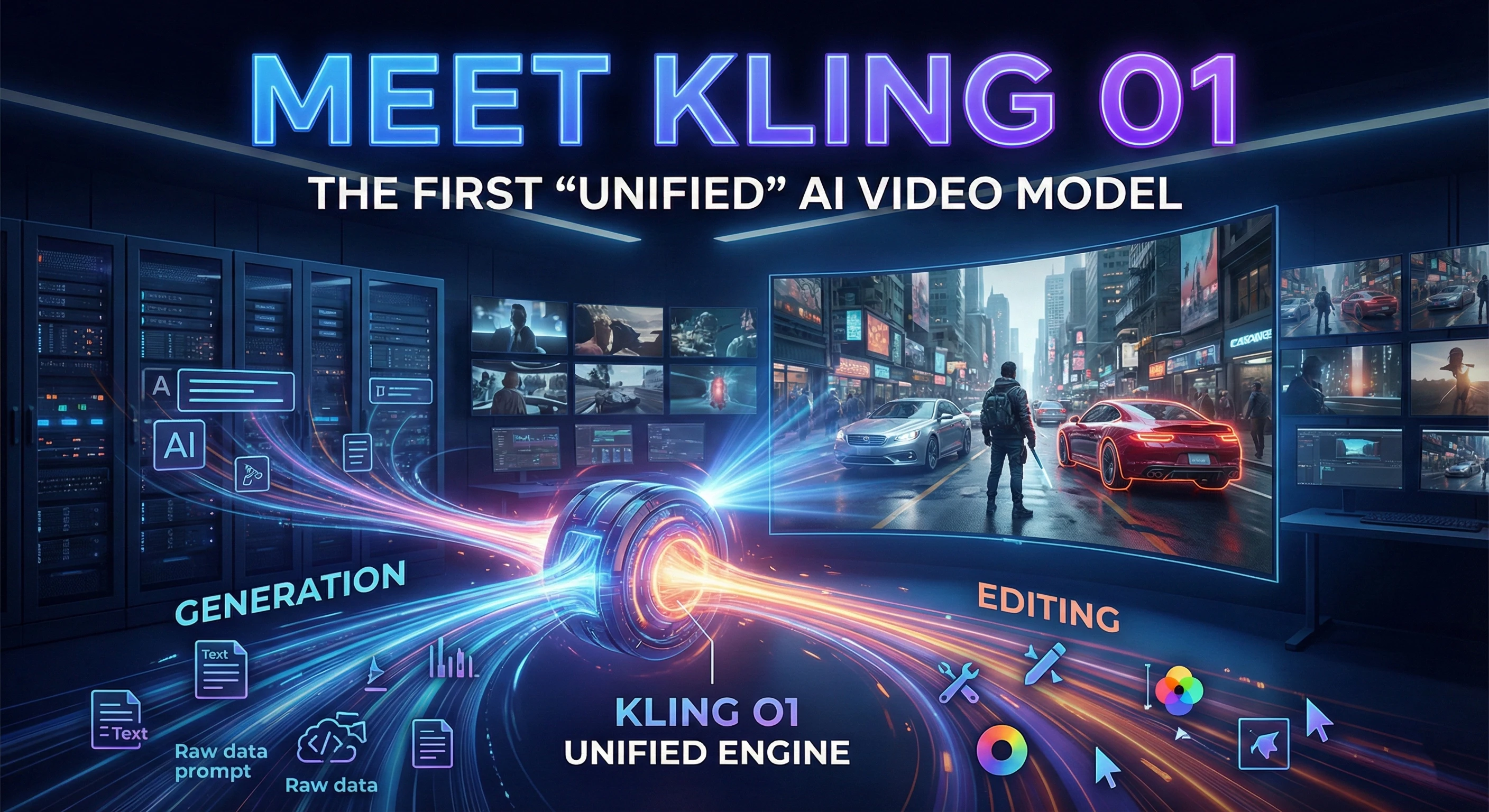
On December 1, 2025, the AI video landscape shifted. While the industry has spent the last year obsessed with higher resolutions and faster frame rates, Kuaishou’s Kling AI released a tool that aims to solve a much deeper problem: Control.
Enter Kling O1, a groundbreaking update marketed as the world's first "Unified All-in-One" video engine.
If you are tired of AI videos that look beautiful but make zero logical sense, this is the update you have been waiting for. By introducing "reasoning" capabilities into the video generation process, Kling O1 is moving us from the era of "random generation" to the era of "directed creation." Let’s look at the specific features that set this model apart from competitors like Runway and Luma.
What Makes the Kling O1 Model Different?
To understand the hype, you first need to understand the old workflow. Until now, AI video tools treated "creating a video" and "editing a video" as two separate worlds. You would generate a clip, export it, and then struggle to fix mistakes in external software.
The new Kling O1 Model changes this architecture. It is built as a "Unified" system where generation, editing, extension, and repainting all happen within the same neural network.
This "Unified" approach allows the model to understand the context of your video much better than its predecessors. Instead of just painting pixels based on keywords, Kling O1 seems to possess a degree of "reasoning" (hence the "O1" name, likely a nod to OpenAI's reasoning models). It attempts to understand the physics, lighting, and 3D space of your scene before it starts rendering.
The Killer Feature: Natural Language Editing
The most tangible benefit of this new architecture is Natural Language Editing.
In previous models, if you generated a perfect street scene but hated the color of a car, you had to re-roll the entire video and hope for the best. With Kling O1, you can simply act as a director.
You can type prompts like "change the silver car to red" or "remove the tree in the background." Because the model understands the semantic logic of the scene, it modifies the specific object while preserving the original motion, lighting, and shadows. This level of control effectively kills the "slot machine" frustration of older AI tools.
Solving the Morphing Problem: Kling O1 Character Consistency
For filmmakers and storytellers, the single biggest frustration with AI video has been the "morphing" effect. You generate a character in Scene 1, but by Scene 2, they look like a completely different person.
This is where the update truly shines. The improved Kling O1 character consistency is arguably its most critical feature for professional workflows.
Because the model supports "Subject Reference" natively within its unified architecture, it can "lock on" to a character's facial features and clothing. Whether your character is turning around, walking into a shadow, or changing facial expressions, the Kling O1 character consistency ensures they remain recognizable throughout the sequence. This is a massive leap forward for anyone trying to create narrative content or AI movies.
Kling O1 vs. Runway Gen-3/Luma Dream Machine: A Quick Comparison
How does it stack up against the heavyweights?
- Kling O1 Vs. Runway Gen-3: Runway is still the king of cinematic "vibes" and texture. However, it functions largely as a generator. If you need precise control over the action or need to edit specific elements without re-rolling, Kling O1 offers a superior workflow.
- Kling O1 Vs. Luma Dream Machine: While Luma is excellent for speed and dynamic motion, Kling O1's "Reasoning" engine provides better adherence to complex physical logic and object interactions.
In short: Use Runway for abstract beauty; use Kling O1 when you need the video to make logical sense.
Conclusion
The release of Kling O1 signals a maturity point for the industry. By combining the power of the Kling O1 Model with industry-leading Kling O1 character consistency, creators finally have a tool that respects their intent.
Kling O1 is currently available to users via the Kling AI web platform.
We are no longer just rolling the dice; we are starting to actually direct.