Grok 4.7 Is Here: What's New, Key Features, and How It Compares to Grok 4.6
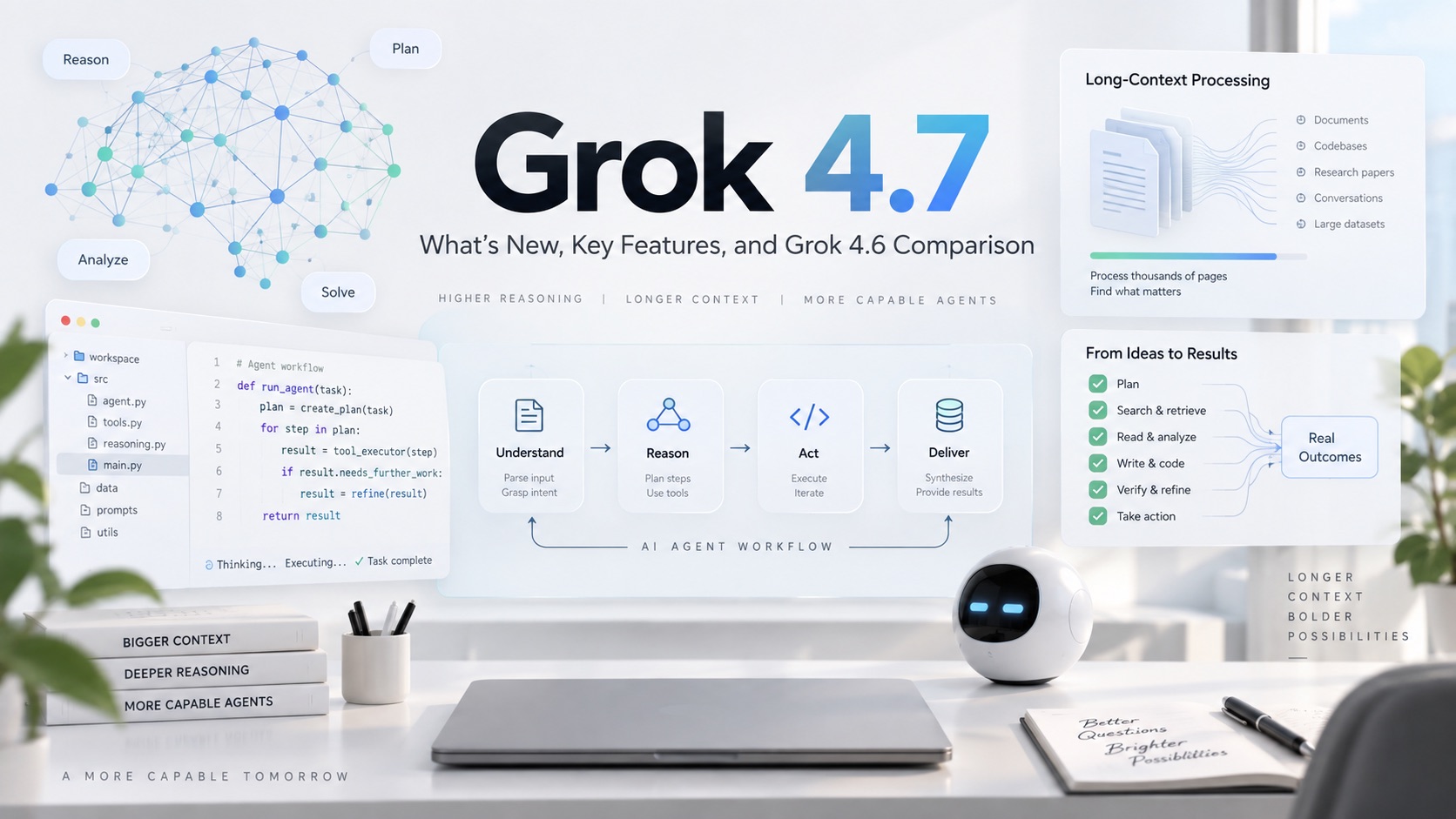
Discover what's new in Grok 4.7, including coding, advanced reasoning, AI agent capabilities, and self-verification. Compare Grok 4.7 vs Grok 4.6, explore benchmark results, and learn about API pricing and practical applications.
Grok 4.7 has officially arrived, bringing another update to the Grok family of AI models. Released on September 21, 2026, the new model focuses on a practical challenge in artificial intelligence: helping users complete difficult tasks that require more than generating a quick answer.
Developed by xAI, Grok 4.7 introduces improvements in software engineering, extended reasoning, AI agent workflows, and professional knowledge work. The model is designed to work through complicated problems, use tools, maintain context, and check its results before completing a task.
But how different is Grok 4.7 from Grok 4.6? What can users actually accomplish with the new model, and is it suitable for image or video generation?
This guide explores the key features, technical specifications, benchmark results, and real-world applications of Grok 4.7.
What Is Grok 4.7?
Grok 4.7 is a large language model developed by xAI for advanced reasoning, coding, agentic tasks, and knowledge work.
Unlike models designed primarily for short conversations or simple content generation, Grok 4.7 places greater emphasis on completing multi-step assignments. These might involve understanding a large codebase, researching an unfamiliar subject, preparing a detailed report, or working through a technical problem that requires several rounds of verification.
According to its official announcement, Grok 4.7 uses a new, larger base model than Grok 4.6. Its development also involved a longer reinforcement learning process, with additional emphasis on difficult problems that can take many hours to complete.
The result is a model intended to maintain progress across complicated workflows rather than simply produce longer responses.
Grok 4.7 Technical Specifications
Here is an overview of the model's main specifications:
| Specification | Grok 4.7 |
|---|---|
| Developer | xAI |
| Release Date | September 21, 2026 |
| API Model ID | grok-4.7 |
| Context Window | 500,000 tokens |
| Knowledge Cutoff | May 2026 |
| Supported Inputs | Text and images |
| Output | Text |
| Reasoning Effort | Low, Medium, High, Xhigh |
| Function Calling | Supported |
| Structured Outputs | Supported |
| Web and X Search | Supported through available tools |
The 500,000-token context window is particularly useful for assignments involving extensive documents, long conversations, or large amounts of source code.
However, a large context window does not guarantee that every detail will be recalled or interpreted perfectly. Clear instructions and relevant source material remain important.
What's New in Grok 4.7?
Grok 4.7 introduces improvements in coding, long-running tasks, self-verification, and AI agent capabilities. These updates focus on helping the model handle complex workflows more effectively.
1. Improved Coding and Software Engineering
Grok 4.7 offers stronger coding capabilities, including writing, debugging, reviewing, and refactoring code. It can also help developers work with larger codebases and manage multi-step software development tasks.
2. Better Performance on Long-Running Tasks
Grok 4.7 is designed to handle complex assignments that require multiple steps and extended reasoning. It can maintain context, follow instructions, and work through dependent tasks rather than treating every request as an isolated question.
3. More Careful Self-Verification
Grok 4.7 places greater emphasis on checking its work before completing a task. This can help the model identify potential mistakes, review intermediate results, and improve the reliability of coding and knowledge-work outputs.
4. Stronger AI Agent Capabilities
Grok 4.7 supports agentic workflows that involve tool use, information retrieval, and multi-step execution. When connected to supported tools, it can help automate research, coding, document processing, and other professional tasks.
Grok 4.7 vs Grok 4.6: What's the Difference?
Grok 4.6, released on August 12, 2026, already emphasized long-running agents, coding, and complex interactive work.
Grok 4.7 builds on that direction with a larger base model, additional reinforcement learning, and stronger emphasis on self-verification.
The differences are most visible in the benchmark results published alongside the new model.
Grok 4.7 vs Grok 4.6 Benchmark Results
| Benchmark | Grok 4.6 | Grok 4.7 |
|---|---|---|
| CursorBench 4.0 | 40.4% | 46.3% |
| DeepSWE v1.1 | 65.2% | 71.0% |
| Terminal-Bench 4.0 | 20.3% | 38.0% |
| HealthBench Professional | 48.5% | 56.7% |
| EEBench | 53.0% | 64.0% |
Source: xAI's official Grok 4.7 announcement. The Grok 4.7 DeepSWE figure uses high reasoning effort; its other results in this table use the xhigh configuration.
These results indicate improvements across several areas, although benchmarks should not be treated as guarantees of performance on every real-world task.
CursorBench evaluates software engineering capabilities, while Terminal-Bench examines performance on tasks involving terminal-based operations.
HealthBench Professional and EEBench cover different specialized domains, providing additional information beyond general coding performance.
For users already working with Grok 4.6, the most relevant differences are likely to emerge during assignments that involve several related steps, substantial context, or repeated problem-solving.
What Can You Do With Grok 4.7?
The technical improvements become easier to understand when connected to practical applications.
Here are several ways individuals and teams can use Grok 4.7.
Software Development and Debugging
A developer working on an existing project can use Grok 4.7 to investigate bugs, understand unfamiliar code, or plan a new feature.
For example, imagine an application that experiences unexpected errors when users upload large files.
Rather than asking the model to rewrite the entire application, the developer can provide the relevant code and request an investigation of the upload process.
Grok 4.7 can help identify possible causes, suggest changes, and explain how to validate the proposed solution.
When appropriate execution tools are available, the workflow can also include testing and further revisions.
Research and Document Analysis
Grok 4.7 can assist with projects involving substantial amounts of written information.
Users can provide reports, technical specifications, research materials, or business documents and ask the model to identify important details.
For instance, a team comparing several technical approaches might ask the model to extract implementation requirements, explain trade-offs, and organize the findings into a structured document.
The large context window can make it easier to work with multiple related sources within one assignment.
When the answer depends on recent developments beyond the model's May 2026 knowledge cutoff, connected search tools can provide additional information.
Creating Professional Documents and Presentations
Grok 4.7 is also designed for professional knowledge work.
The model can help organize information, develop an outline, rewrite complicated explanations, and prepare structured content for reports or presentations.
A product manager might use it to turn scattered project notes into a clear proposal, while a technical writer might use it to transform product documentation into a more accessible guide.
The actual creation and editing of files depend on the capabilities of the platform hosting the model.
Technical Planning and Problem-Solving
Not every useful AI task involves producing code or written content.
Some assignments require examining constraints, comparing alternatives, and developing a sequence of actions.
For example, a business planning a new internal workflow might use Grok 4.7 to organize requirements, identify dependencies, and draft an implementation plan.
The model can help users explore these decisions, but important operational, financial, legal, or medical conclusions still require appropriate human review.
Can Grok 4.7 Generate Images and Videos?
Grok 4.7 and Grok Imagine belong to the broader Grok product ecosystem, but they serve different purposes.
The Grok 4.7 API supports text and image inputs with text output.
This means users can provide an image and ask Grok 4.7 to describe its contents, examine visible details, or answer questions about the image.
For example, someone could upload a screenshot of an error message and request help understanding the problem.
However, Grok 4.7 is not itself an image-generation or video-generation model.
Grok Imagine provides the dedicated image and video creation capabilities within the Grok ecosystem.
The distinction matters because being able to understand an image is different from generating a new image or producing an animated video.
Users looking for AI coding, reasoning, or document analysis should focus on Grok 4.7's language-model capabilities. Those looking to create visual content should explore the appropriate Grok Imagine models and tools.
Grok 4.7 API Pricing and Availability
Grok 4.7 is available through the xAI API and supported development environments, including Grok Build and Cursor.
GitHub also announced a gradual rollout of Grok 4.7 in GitHub Copilot beginning September 21, 2026.
Developers can access the model through the API using the model identifier grok-4.7.
The published base pricing is:
| Token Type | Price per Million Tokens |
|---|---|
| Input | $2.00 |
| Cached Input | $0.50 |
| Output | $6.00 |
For requests exceeding 200,000 prompt tokens, the published rates increase to $4 per million input tokens, $1 per million cached input tokens, and $12 per million output tokens.
These figures refer to API usage. Platform subscriptions, tool usage, and additional services may have separate pricing.
Grok 4.7 also supports four reasoning-effort settings: Low, Medium, High, and Xhigh.
Developers can select the appropriate setting based on the complexity of the task, performance requirements, and usage budget.
Final Thoughts: What Grok 4.7 Means for AI Users
Grok 4.7 represents another step toward AI models that can support complete assignments rather than isolated prompts.
Its improvements in coding, extended reasoning, self-verification, and agentic workflows are particularly relevant for developers and professionals working with complex information.
The transition from Grok 4.6 to Grok 4.7 is not primarily about introducing a new creative effect or changing the basic chat experience. It is about improving how the model handles demanding tasks that involve multiple decisions, extensive context, and opportunities for error.
For everyday users, this could mean more capable assistance with difficult questions, research, and structured writing. For developers, the improvements may become more noticeable when the model is connected to coding tools and allowed to work through several stages of a project.
As AI systems become increasingly integrated into professional workflows, the ability to plan, execute, verify, and revise work will remain an important area of development.
Grok 4.7 is part of that ongoing evolution, with a clear focus on making advanced AI more useful for complex, real-world tasks.