What Is Jev? How TypeSafe AI’s System One Model Works
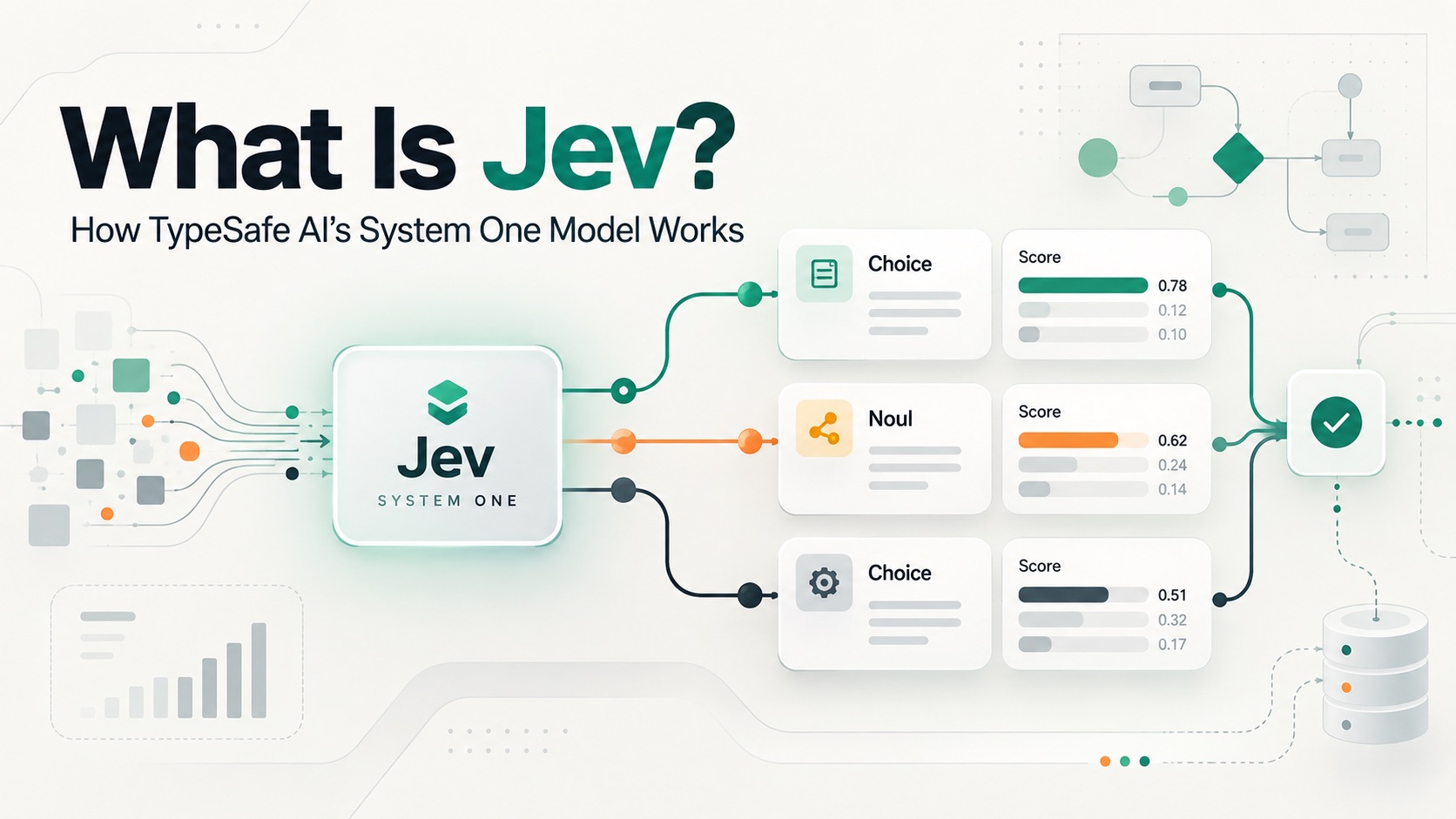
Jev is TypeSafe AI’s first System One Model, built for fast, structured decisions instead of long-form text generation. This guide explains how Jev works, how it differs from traditional LLMs, and where decision-focused AI can fit into modern software workflows.
Large language models have become remarkably good at writing, coding, answering questions, and following natural-language instructions. But many software systems do not actually need another paragraph of generated text. They need a decision.
Should this support ticket go to billing or technical support? Is this search result relevant enough to show? Does an action look risky? Which tool should an AI agent use next? Should an automated workflow continue, stop, or ask a human for review?
That is the problem TypeSafe AI is trying to address with Jev, its first public System One Model. Announced in September 2026 and released in early access, Jev is designed around fast, structured decisions rather than free-form text generation. TypeSafe describes the basic pattern as unstructured state going in and typed, probabilistic decisions coming out.
This makes Jev quite different from the AI models most people interact with today. Instead of asking a model to generate more words, developers can use Jev when software simply needs to decide what something means, where something should go, how strongly a condition applies, or what should happen next.
What Is Jev?
Jev is an AI model developed by TypeSafe AI for making structured decisions that software can consume directly. It is the company's first public model in a category it calls System One Models.
A conventional large language model normally receives text and generates more text. Even when developers ask an LLM to return JSON, the underlying system is still generating output token by token.
Jev takes a different approach. A program provides some state, such as a customer message, search result, application event, document, security alert, or structured data, and then asks one or more predefined questions about that state.
Instead of writing an explanation, Jev returns an answer within a structure defined by the developer, together with probability and confidence information.
Imagine that a company receives the following customer message:
“I was charged twice for the same order and need the extra payment refunded.”
A traditional chatbot could generate a helpful response explaining what the customer should do. Jev could instead be asked which department should handle the request.
The permitted answers might be billing, technical_support, sales, or other. Jev evaluates those possibilities and produces a structured decision that the surrounding software can immediately use.
That difference is fundamental. Jev is primarily designed to answer the question “What should the software decide?” rather than “What should the AI say?”
Why TypeSafe Calls Jev a System One Model
The term System One is inspired by the distinction between fast and slow thinking associated with Daniel Kahneman's Thinking, Fast and Slow. TypeSafe uses the term to describe models intended to make rapid judgments inside software rather than produce long, deliberative responses for people.
The analogy should not be taken too literally. Jev is not trying to reproduce human intuition. The more useful distinction is about what the model is optimized to do.
Most general-purpose LLMs are optimized for flexible language generation. That flexibility is one of their greatest strengths. The same model can answer a question, write an email, create code, summarize a document, brainstorm ideas, or hold a conversation.
But flexibility can become inconvenient when a model is placed deep inside software. The application may need to parse the model's response, validate the output, check whether required fields exist, reject unexpected values, and determine what to do when the answer is uncertain.
Jev deliberately narrows the problem. The application defines what kinds of answers are possible before the model responds. Jev then evaluates those predefined possibilities.
In simple terms, a traditional LLM has an extremely open output space. Jev has a bounded decision space.
| Traditional LLM | Jev |
|---|---|
| Primarily generates text | Primarily makes structured decisions |
| Output can be almost anything | Possible outputs are defined in advance |
| Often optimized for human interaction | Designed for decisions inside software |
| Responses may require parsing and validation | Typed results are designed for programmatic use |
| Strong for writing, conversation, coding, and generation | Strong for classification, routing, scoring, and branching |
| Usually generates output sequentially | Designed to produce structured outputs in parallel |
| Can be asked for confidence but may be inconsistent | Confidence and probabilities are part of the decision interface |
TypeSafe says the System One stack also uses a training approach called Reinforcement Learning for Calibrated Decisions, or RLCD. The goal is not only to select an answer but also to produce useful estimates of uncertainty around that answer.
Jev Is Not Just a Faster Chatbot
One of the easiest ways to misunderstand Jev is to think of it as a smaller or faster chatbot. That misses the main idea.
Suppose a developer asks a conventional LLM:
“Which team should handle this support request?”
The model might reply:
“This appears to be a billing issue because the customer is reporting a duplicate charge. I recommend routing the request to the billing team.”
For a person, that response is perfectly useful. For software, however, most of those words are unnecessary. A program may only need a value such as billing, together with information about how confident the model is in that decision.
Jev gives up general-purpose string generation and focuses on structured decisions. TypeSafe argues that this allows the model to avoid spending resources generating long sequences of text when the application only needs a small decision.
That also means Jev is not intended to replace GPT-style models across every task. If an application needs to write a product description, explain a technical problem, summarize a report, create code, or hold a conversation, a generative model is still the more natural choice.
Jev becomes more relevant when the desired output is a classification, probability, score, route, or other bounded decision.
The Three Main Jev Decision Types
TypeSafe's workflow system uses three main question types: Noul, Choice, and Score. Together, they cover many of the small decisions that appear inside software workflows.
Noul: Is Something True?
Noul represents a yes-or-no judgment, but it does not simply return a hard true or false. The model produces a probability indicating how strongly the available state supports the statement.
For example, a system could ask:
Does this customer message request a refund?
A value near 1 would indicate strong support for yes, while a value near 0 would indicate strong support for no. A value closer to the middle would indicate greater uncertainty.
That makes Noul useful for questions such as whether a message contains a certain intent, whether an action appears suspicious, whether enough information is available to continue, or whether a document meets a particular condition.
The application can then decide what probability is high enough to trigger an automatic action.
Choice: Pick One Option From a Defined Set
Choice is used when there are several possible outcomes and the model needs to decide which one best fits the current state.
A customer service system might define the following choices:
- Billing
- Technical support
- Account access
- Sales
- Other
Jev evaluates the options and returns a probability distribution across the choices, along with confidence information.
Choice can therefore be useful for customer-intent classification, workflow routing, document categorization, model selection, agent routing, or deciding which tool should handle a task.
An important property of this approach is that the application defines the choices. If only five categories are permitted, the model does not suddenly invent a sixth category that the surrounding software does not understand.
Score: Measure Something on a Scale
Some decisions are not simple yes-or-no questions and do not fit neatly into separate categories. The application may instead need to measure the degree of something.
For example, a developer could define a scale for software incident severity:
- Minor inconvenience
- Significant issue with a workaround
- Major issue affecting important functionality
- Critical failure blocking the service
Jev can evaluate the state against the scale and return a score, a distribution across the levels, and confidence information.
Score is useful for concepts such as urgency, relevance, quality, severity, priority, or risk. Instead of asking a model to invent an unexplained number from 1 to 10, developers can define what different levels actually mean.
Why Probabilities and Confidence Matter
Structured output alone does not solve every automation problem. Real-world information is often ambiguous, and a useful AI system needs some way to represent that uncertainty.
Consider a customer message saying:
“I'm not sure whether I was charged twice. There are two transactions on my statement, but one might still be pending.”
A reliable system should not necessarily treat that case with the same certainty as a message that explicitly says two completed charges appeared for the same purchase.
TypeSafe makes confidence and probability a central part of Jev's design. Rather than hiding uncertainty behind a single definitive answer, Jev is intended to expose information that the surrounding software can use when deciding how aggressively to automate.
A workflow could therefore use logic such as:
- High confidence → act automatically
- Moderate confidence → perform another check
- Low confidence → ask for human review
This separation is important. Jev can make the fuzzy judgment, while ordinary software still controls thresholds, permissions, business rules, and final actions.
The AI does not need to control the entire workflow.
Jev as a Smart If Statement
One useful way to think about Jev is as a more flexible version of an if statement.
Traditional software might contain a rule such as:
IF message contains "refund" THEN send to billing
That works when users use exactly the words anticipated by the developer. It becomes less reliable when someone writes:
“Can I get my money back?”
The meaning is obvious to a human, but the word refund never appears.
Developers can keep adding keywords, regular expressions, exceptions, and additional rules, but eventually the logic becomes difficult to maintain.
A general-purpose LLM can understand the meaning much better, but generating a paragraph of text simply to decide which branch of code should run may be unnecessary.
Jev targets that middle layer. TypeSafe describes System One workflows as something similar to “smart if-statements”: AI-powered decisions used where hard-coded logic is too rigid but unconstrained text generation is not necessary.
This can include classification, routing, scoring, extraction, verification, guardrails, and branching.
Why Small Decisions Matter in AI Workflows
Many real-world AI systems are not built around one giant decision. They contain dozens of smaller judgments.
Imagine a customer-service workflow. The system may need to determine whether the message is urgent, identify the customer's intent, check whether the user is asking for a refund, determine whether the account information is sufficient, check whether a previous action has already been completed, and decide whether the request can be handled automatically.
A single large prompt could ask one model to solve everything at once. But another approach is to decompose the process into narrow questions.
For example:
Is this request urgent?
Which department owns the issue?
Does the customer want a refund?
Is the available evidence sufficient?
Should this case be escalated?
The results can then be combined using normal application logic.
This is a major part of the System One approach. The AI handles judgments that are difficult to express as rigid rules, while code handles deterministic logic.
The result is a workflow where intelligence and software logic are separated rather than mixed together inside one long prompt.
Parallel Decisions Change the Cost of This Approach
Breaking a problem into many small questions sounds useful, but it could become slow if every question required a separate long LLM response.
Jev is designed around parallel structured outputs. TypeSafe says the model can evaluate multiple decisions in a single query rather than generating a long sequence of tokens one after another.
This matters because a production workflow may contain many independent judgments.
A support workflow could simultaneously evaluate intent, urgency, eligibility, fraud risk, missing information, and escalation requirements. A security workflow might evaluate credentials, network activity, persistence, suspicious processes, and the severity of an incident.
Instead of asking for a large natural-language report and then trying to turn that report back into software logic, the application can request the decisions it actually needs.
That is one of the clearest architectural differences between Jev and ordinary chatbot-style use of AI.
What Can Jev Be Used For?
Because Jev is focused on structured decisions, the same model pattern can be applied to very different kinds of software.
Search and Reranking
A search system may retrieve dozens or hundreds of potentially relevant results. Jev can help evaluate whether each result is relevant to the user's actual intent or determine which results deserve higher priority.
Instead of generating a search result itself, the model acts more like a judge sitting between retrieval and the final ranking.
Agent and Model Routing
AI systems increasingly contain multiple models, tools, and specialized agents. Before executing a task, the system needs to decide which component should receive it.
Jev can be used as a router that evaluates a request and selects from a predefined set of possible destinations.
For example, an AI platform might need to choose between a coding agent, research agent, image model, search tool, or human reviewer. The decision itself may only require a structured choice rather than another full generative response.
Context Filtering
AI agents often collect far more information than they actually need. A search process may retrieve dozens of pages, documents, messages, or database records.
A decision model can evaluate whether each piece of information is relevant before it reaches a larger model. This can reduce unnecessary context and allow the next stage of the workflow to focus on more useful information.
Content and Security Checks
Software frequently needs to judge whether content or actions satisfy particular conditions. A system may need to determine whether an action looks risky, whether a piece of evidence supports a claim, whether content meets a quality threshold, or whether a prompt appears suspicious.
These tasks naturally fit yes-or-no judgments, scoring systems, and predefined categories.
Real-Time Decisions
TypeSafe has also demonstrated Jev in real-time environments such as Doom and Wikipedia navigation challenges.
The important point is not that Jev is a gaming model. These demonstrations show what happens when a model can repeatedly inspect structured state and make bounded decisions quickly enough to participate in an interactive loop.
The same principle can apply beyond games whenever software needs a large number of low-latency decisions.
Can Jev Hallucinate?
TypeSafe describes Jev as having zero hallucinations, but this claim needs to be understood in the context of its structured output design.
A generative model can produce an answer that does not match the expected schema. It might invent a new field, return malformed JSON, ignore the requested categories, or generate an output that software cannot parse.
Jev avoids this category of failure because its output space is defined in advance. TypeSafe states that schema matching is guaranteed, meaning the model does not make type errors.
Suppose the only permitted choices are:
- Spam
- Legitimate
Jev will not return an unexpected third value such as “probably a newsletter.”
However, that does not mean the model can never make an incorrect judgment.
Jev could return spam when the correct answer is actually legitimate. The answer would be structurally valid but semantically wrong.
That distinction is important: type safety guarantees the form of the answer, not that every decision is correct.
TypeSafe itself acknowledges that Jev can get things wrong. Confidence and probability are therefore important because they give the surrounding application another signal for deciding when to trust a result and when to escalate it.
Jev vs. JSON Mode in Traditional LLMs
At first glance, Jev may sound similar to asking an LLM to return JSON or use structured outputs. Both approaches can produce information in formats that software understands.
The difference is deeper than the surface format.
A traditional LLM remains a generative model even when its output is constrained to JSON. It still generates tokens sequentially and is fundamentally built around string generation.
Jev is designed around typed decisions as the native output itself. TypeSafe's architecture, sampling method, and training approach are specifically aimed at software decision tasks.
That means the comparison is not simply “plain text versus JSON.” It is the difference between taking a general-purpose generative model and constraining its output, versus designing a model around structured decisions from the beginning.
How Fast Is Jev?
Speed and cost are major parts of TypeSafe's argument for System One Models.
TypeSafe currently reports end-to-end Jev response times of roughly 70 to 500 milliseconds in its service environment. The company also reports large cost and latency improvements in its own workflow evaluations, including headline figures of up to 193.6 times faster and 444.6 times cheaper for the System One workflows it tested.
Those numbers should be interpreted in context.
TypeSafe notes that these workflow results represent tasks shaped specifically around structured System One decisions and that the largest gains may be toward the high end of what users see in practice. Jev is also in early access, meaning infrastructure, pricing, model behavior, and performance may continue to change.
The broader idea is more important than any one benchmark number. If an application only needs a small structured judgment, avoiding long autoregressive output can significantly change the economics of making that judgment repeatedly.
That becomes especially relevant when a workflow makes hundreds, thousands, or millions of small AI decisions.
Jev Does Not Replace Large Language Models
The most useful way to think about Jev is not as a competitor that must replace every LLM.
The two types of models can perform different jobs inside the same system.
Imagine an AI customer-support application. Jev could classify the customer's intent, estimate urgency, determine whether sufficient information is available, and decide which workflow should handle the case. A generative LLM could then write the actual response sent to the customer.
An AI agent could work similarly. A larger reasoning model might create a plan or perform a difficult analysis, while Jev could handle smaller decisions around routing, verification, tool selection, filtering, or escalation.
The architecture might look something like this:
Observe → Decide → Route → Act → Generate when needed
This division allows each type of model to focus on what it is designed to do.
Generative models remain valuable because they can produce flexible language and handle open-ended tasks. Jev explores the opposite tradeoff: deliberately restricting the output space so that AI decisions can fit more naturally inside ordinary software.
Where Jev Still Has Limits
Jev's specialization also creates clear limitations.
It is not intended for tasks that fundamentally require rich text generation. If the goal is to write an article, explain a difficult subject, generate code, create dialogue, or produce an original response, a generative model is a better fit.
Structured decision models also depend heavily on how developers define the problem. Poorly designed categories, unclear scoring levels, missing state, inappropriate thresholds, or ambiguous questions can still lead to bad decisions.
A reliable workflow therefore requires more than simply adding Jev. Developers still need to decide which questions should be handled by AI, which rules should stay in code, how much confidence is required before an action is automated, and what should happen when the model is uncertain.
Jev is also very new. It was publicly introduced in September 2026 and remains in early access. Its ecosystem, third-party tooling, independent evaluations, and long-term production record are therefore much less mature than those of established LLM platforms.
Early demonstrations show what the approach can do, but they do not prove that every workflow should be rebuilt around it.
The Bigger Idea Behind Jev
For the last several years, much of AI development has focused on making language models better at generating increasingly sophisticated responses. Better conversations, better code, better reasoning, longer context windows, and more capable agents have all emerged from that direction.
Jev explores a different question.
What if many applications do not need more generated language at all?
A search engine may only need to know which result is more relevant. An automated workflow may only need to know which branch to follow. An agent may only need to select its next tool. A security system may only need to know whether a particular action deserves further review.
In each case, the useful output is not a paragraph. It is a decision.
That is what makes Jev and the broader System One Model concept interesting. Instead of treating text generation as the universal interface for machine intelligence, TypeSafe is experimenting with models whose outputs look more like the values already used by software.
Jev does not make generative AI obsolete, and it is too early to know how broadly the System One approach will be adopted. But it highlights an important distinction that will likely matter more as AI becomes embedded deeper inside applications.
Some problems need a model that can explain.
Others need a model that can decide.