World Labs Atlas Explained: More Than an AI Video Model
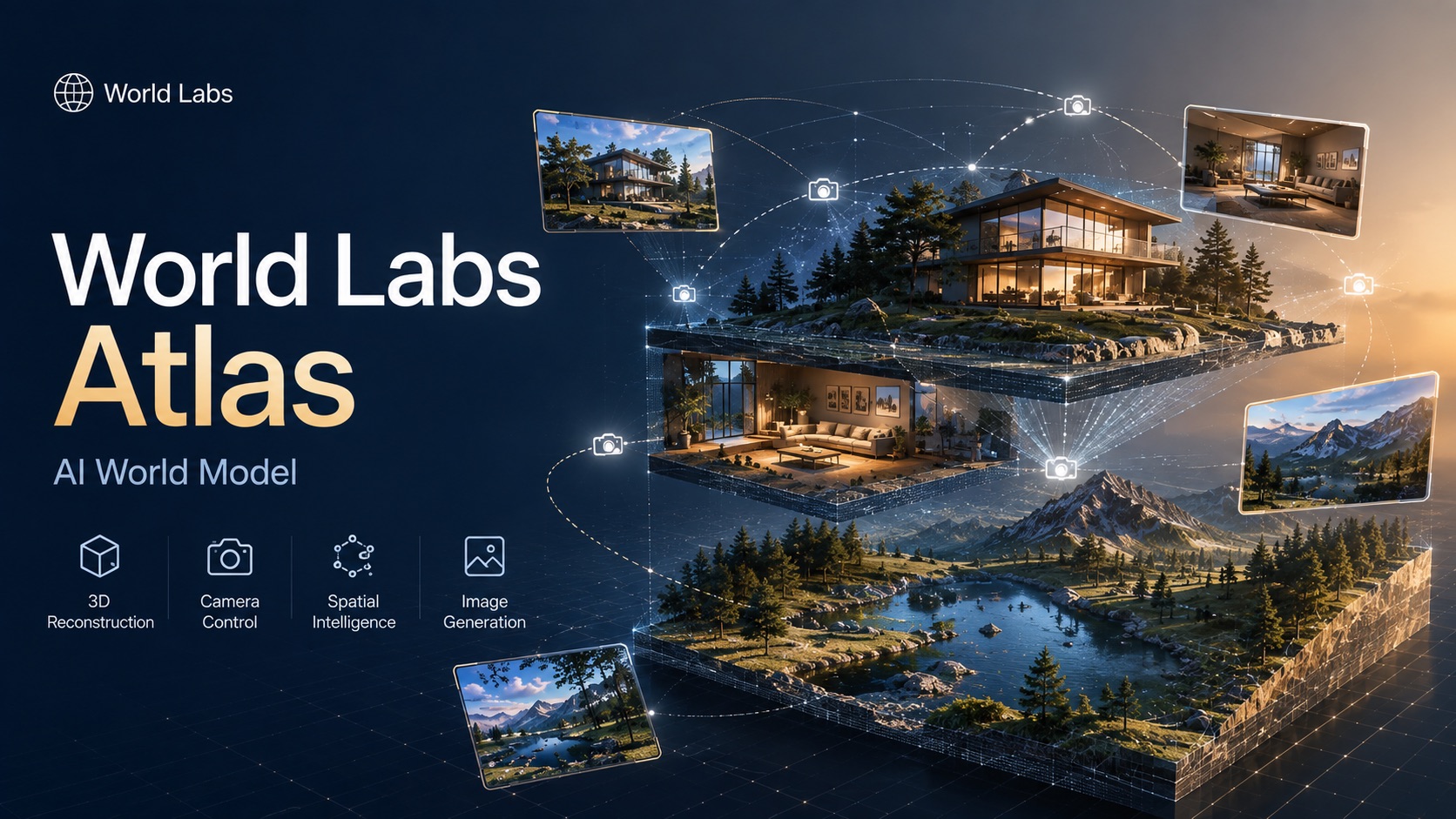
Explore how World Labs Atlas uses spatial intelligence to generate images, control camera movement, reconstruct 3D environments, model space across time, and support simulation and robotics.
AI image generators have become remarkably good at creating convincing photographs, illustrations, product visuals, and imaginary scenes from a few lines of text. AI video models have gone further, adding motion, camera movement, and increasingly long sequences. World Labs’ Atlas points toward something broader.
Instead of asking only how AI can generate a better image or a longer video, Atlas explores a different problem: can a generative model understand the space that those images and videos belong to?
Introduced by World Labs in September 2026, Atlas is described as an omni world model built for spatial intelligence. It works across text, images, video, camera information, depth, and 3D data. That means Atlas is not best understood as another AI video generator with stronger camera controls. Video is only one part of what it can do.
Its larger goal is to model a world, then allow that world to be viewed, reconstructed, or simulated from different positions.
What Is World Labs Atlas?
Atlas is a multimodal world model developed by World Labs, the spatial intelligence company co-founded by computer vision researcher Fei-Fei Li. The idea that makes Atlas different is what World Labs calls spatial context.
A conventional image model can look at a picture and understand what appears inside the frame, while a video model can also learn how the visible scene changes over time. Atlas goes further by associating visual information with positions and viewpoints in three-dimensional space.
Imagine giving a model one image of a house. A normal image generator only needs to reproduce or modify what the picture shows, but Atlas also has to consider what might exist if the virtual camera moved around the side of the building, rose above the roof, or looked back toward the garden from another direction.
Those unseen areas were never captured in the original image. A world model therefore has to do more than generate attractive pixels. It needs some representation of the larger space around the camera.
This is the key difference. A conventional visual model mainly asks: What should this frame look like? Atlas is trying to answer something closer to: What kind of world could contain this frame, and what should that world look like from another position?
That spatial idea is what connects most of Atlas’ capabilities.
Atlas Can Generate More Than Video
Atlas has received a lot of attention for its camera-controlled video demonstrations, but treating it only as a video model misses a large part of what makes it interesting. The same model can work across several types of visual output, including text-to-image generation, 360-degree panoramas, new viewpoints based on existing images, camera-controlled video, and reconstructed 3D scenes.
Atlas can generate still images in different visual styles and can also render text inside generated images. World Labs does not present standard image generation as the model’s main research focus, but it is still part of the same system.
Its 360-degree panorama generation is more closely connected to the idea of world modeling. A normal image only needs to create one rectangular composition, while a panorama has to represent much more of the environment around the viewer. That naturally pushes the model toward thinking beyond a single camera frame.
Atlas can also use an existing image as a reference and generate views from camera positions that were never part of the original photograph. If the new camera moves to the side of a building, for example, the model must generate parts of the structure that were previously invisible. The same applies to objects, rooms, streets, landscapes, or any other scene where the camera moves beyond the original viewpoint.
These capabilities may look different on the surface, but they are closely related. An image, a panorama, a novel view, and a video can all be treated as different ways of observing the same spatial environment.
That is why Atlas is better described as a world model than as a collection of separate image and video features.
Why Camera Control Is Different in Atlas
Camera control is one of the easiest places to see the difference between Atlas and a conventional AI video model. Many current video generators already support instructions such as “slowly pan to the right,” “dolly toward the subject,” “orbit around the character,” or “crane upward.”
These commands can work well, but they are still language instructions. The creator describes the desired motion, and the model decides how that description should translate into an actual camera path.
Atlas can instead work with explicit camera geometry. World Labs describes this as pixel-perfect camera control, where the location and movement of the virtual camera become part of the model’s input rather than only something described in a prompt.
The difference is roughly:
- Prompt-based camera control: Tell the model how you want the camera to move.
- Spatial camera control: Define where the camera is and where it should go.
That distinction matters most when a shot needs to be deliberately designed rather than simply generated. World Labs has shown Atlas creating video from one to six reference images while following manually designed camera paths, including examples reaching up to one minute at 1440p.
The length and resolution are useful, but they are not the most important part. The bigger change is that the creator can treat camera movement more like part of scene construction.
For filmmakers, VFX artists, advertising teams, and previs creators, that could be especially valuable. These workflows depend not only on whether a shot looks good, but also on where the camera starts, what it reveals, and how it moves through the environment.
Atlas therefore shifts the workflow away from repeatedly asking for a “cinematic camera move” and hoping the model interprets it correctly. It moves closer to staging a shot inside a space.
From Reference Images to a Larger World
Atlas becomes even more interesting when multiple reference images are placed inside the same spatial context. A single image gives the model one limited observation of a scene. If parts of the environment are hidden, Atlas has to infer what might exist there.
Add more reference images, however, and the model receives more constraints. For example, imagine giving Atlas one image of the front of a cottage. From that view alone, the model does not know exactly what sits behind the building. Now add another photo showing the side and a third showing the rear garden.
The model no longer has to invent as much. The additional images provide real visual evidence about how the space is arranged. This creates a simple relationship: fewer references give the model more freedom to imagine, while more references give the world more structure.
But Atlas can also use this capability creatively rather than only for reconstruction. One World Labs demonstration places unrelated images at different points inside the same spatial context. One reference might show a living room, while another shows a forest.
Those two places never existed together in the real world, but Atlas can still treat them as parts of one generated environment. The model may create a doorway, hallway, turn, room, or other intermediate area that makes movement between the two references feel plausible.
This is an important shift. Reference images no longer need to serve only as visual style inspiration. They can become spatial anchors.
A creator could define the important parts of an environment with several images and allow the model to work out how those locations might connect. Instead of describing an entire fictional place in one huge prompt, the creator begins by establishing the spaces that matter most.
The model then helps construct the world between them.
How Atlas Turns Images Into 3D Space
Once Atlas has built a spatial understanding from visual references, the output does not have to remain a collection of 2D images. The model also works with depth information and can produce explicit 3D representations, including point clouds and 3D Gaussian splats.
That matters because there is a major difference between generating a convincing new view of a scene and representing the geometry of the scene itself. A new image tells you what one camera might see. A 3D representation can describe where surfaces and structures exist in space.
This makes Atlas relevant to workflows that extend beyond traditional AI media generation. A filmmaker could potentially use a reconstructed location as part of a virtual production environment. A VFX artist could work with scene geometry rather than relying only on generated frames. A game creator could begin with a set of visual references and use them as the foundation for an explorable environment. Architects and designers could inspect concepts from camera positions that were never part of the original images.
Atlas therefore sits somewhere between image generation, 3D reconstruction, and world creation. The same model can move from visual references toward something that can be explored as space.
That is one of the clearest signs that Atlas is aiming beyond ordinary image and video generation.
Atlas Can Model Space Across Time
Static 3D environments are only part of the problem. Atlas can also work with scenes that change over time. World Labs has demonstrated events captured from several camera positions and then reconstructed so that the viewpoint can be changed after recording.
Some of these examples use only around three to five views captured with ordinary devices such as smartphones or action cameras. The result can resemble bullet time, where an event appears frozen while a virtual camera moves around it.
Traditional bullet-time setups often rely on large arrays of synchronized cameras capturing the same moment from many positions. A world model can approach the problem differently. Instead of requiring a camera at every possible angle, Atlas can use the available observations to infer what might exist between them.
The recorded cameras become reference points in space and time, and the model then synthesizes viewpoints that were never directly captured.
The important part is not only the visual effect. Normally, once an event has been recorded, the available camera angles are fixed. If the decisive moment was filmed only from one side, the production has to work with that footage.
A sufficiently capable space-time model changes that assumption. The original camera views become observations of the event rather than the only possible ways to view it.
This could open new possibilities for post-production, VFX, sports capture, cinematic effects, and other workflows where changing the viewpoint after recording would normally be difficult. And once a model can represent both where things are and how they change over time, simulation becomes a natural extension.
Why the Same Technology Matters for Robotics
A virtual movie camera and a robot camera may sound like completely different things, but from the perspective of a world model, they share an important question: What should be visible from this position?
That is one reason Atlas also has potential applications in robotics. Robots need experience with environments, objects, navigation, movement, and changing conditions. Collecting all of that experience in the real world can be expensive and time-consuming.
World Labs presents Atlas as part of a Real-to-Sim workflow, where real environments can be reconstructed and then used as simulations.
Reconstruct the Real Environment
The process can begin with images or video captured in a real location. Atlas can use those observations to reconstruct a spatial representation of the environment, and that reconstructed scene becomes the basis of a simulation.
Place a Virtual Robot Inside
A virtual robot can then be placed inside the reconstructed world. Researchers can test different trajectories, object positions, layouts, or interactions without physically rebuilding the real environment each time.
Generate New Training Observations
Atlas can simulate what the robot’s cameras would see from different positions, including RGB images and depth information. Conditions such as lighting, object placement, and robot motion can also be varied, which can provide additional training or evaluation data.
The creative and robotics use cases therefore have more in common than they first appear to. For a filmmaker, a generated environment is somewhere to put a virtual camera. For a robot, a simulated environment is somewhere to move, observe, and learn.
Both depend on a model that can maintain a meaningful representation of space as the observer changes position.
The Technical Idea Behind Atlas
World Labs describes Atlas as a multimodal autoregressive diffusion transformer.
The phrase sounds complicated, but it can be broken down into four parts:
- Multimodal means Atlas can work across different forms of information, including text, images, video, camera poses, and depth.
- Autoregressive means the model generates new information while conditioning on context that has already been established.
- Diffusion connects Atlas to the generative techniques widely used in modern image and video models.
- Transformer refers to the architecture used to model relationships across those inputs.
The technical ingredients are important, but the more distinctive idea is what they are being organized around: spatial context.
Camera poses are not simply extra metadata. Depth is not only an optional output. Reference images are not treated only as isolated visual examples. They all contribute to the model’s representation of a larger environment.
This is why Atlas can move between tasks that would otherwise seem unrelated, such as generating a panorama, moving a camera through a virtual scene, reconstructing a real location, creating 3D geometry, reframing an event, and simulating what a robot sees.
At a deeper level, they are all variations of a similar problem: Given what I already know about this world, what should be visible from another position or at another moment?
Why Atlas Matters
Atlas is easy to reduce to a feature list. It can generate images, panoramas, camera-controlled video, new viewpoints, 3D representations, and simulated observations.
But the feature list is not the most important part. What matters is the idea connecting those outputs.
Image generation taught AI to answer: What should this frame look like? Video generation added another question: What should happen over the next few seconds? A world model introduces something broader: What kind of space exists around those frames?
That shift becomes important when consistency across viewpoints matters. A filmmaker may want to return to the same generated location from another angle. A VFX artist may want to reframe an event after capture. A game creator may need an environment that can be explored rather than a scene viewed from one fixed camera. A robotics researcher needs the world to remain spatially meaningful as an agent moves through it.
Atlas attempts to bring these problems into one model. It is still an early system. World Labs introduced Atlas in early access with select partners, so it should not yet be treated as a mature consumer tool with a fixed everyday workflow.
But its direction is already clear. The next major step in visual AI may not simply be better images, longer videos, or smoother camera motion.
It may be the ability to create a space that continues to make sense after the camera moves.
Conclusion
World Labs Atlas is more than an AI video model with advanced camera controls. Its more ambitious goal is to give generative AI a stronger understanding of space: where things are, how different viewpoints relate to one another, and what may exist beyond the visible frame.
That spatial foundation is what allows Atlas to connect image generation, 360-degree environments, camera-controlled video, 3D reconstruction, space-time simulation, and robotics.
For creators, that could eventually mean moving away from generating isolated shots and toward building environments that can be explored and filmed from different positions. For VFX, 3D, and robotics workflows, it could offer a bridge between real-world observations and editable or simulated spaces.
Atlas is still in early access, so many of these workflows are only beginning to take shape. But the larger shift is easier to see. Generative AI has spent years learning how to create what appears inside the frame, while world models like Atlas are beginning to ask what exists around the frame as well.
That may be the more important transition: from generating content to generating worlds.