ByteDance's "World Model": From Generating Video to Generating a Space You Can Walk Into
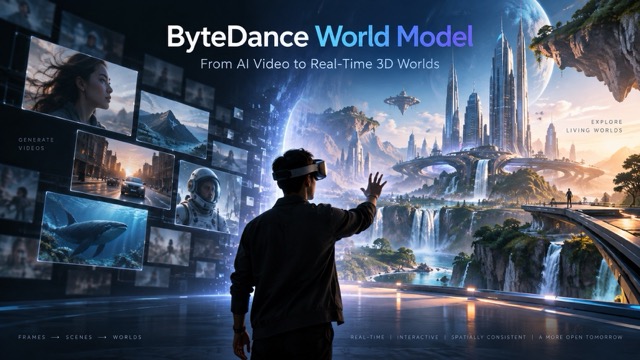
ByteDance’s reported world model could mark a shift from generating fixed AI videos to creating real-time, interactive 3D environments. This article explains how the technology may work, why low latency matters, how it differs from traditional AI video, and what it could mean for gaming, VR, Pico, and the future of AI-generated worlds.
What It Is
According to reporting cited by The Next Web, ByteDance is developing a real-time spatial AI model aimed at generating interactive virtual worlds rather than fixed video clips. The project is reportedly built on ByteDance's Seedance technology, with the heavy computation happening in the cloud and the resulting environment streamed to a device such as a Pico headset. ByteDance has not formally launched the project, and its exact form and timing may still change.
This lines up with a direction ByteDance has already confirmed publicly. Its Seed research organization runs a team called Multimodal Interaction & World Model, whose stated goal is to build models with human-level multimodal understanding and interaction ability. The team's published work so far includes SeedRealtime, Seed3D 2.0, and BAGEL.
The short version: ordinary AI video generates something you watch. A world model generates something you can enter and interact with.
What It Can Do
Based on the reporting and ByteDance's public research, this kind of world model breaks down into three capabilities:
- Real-time generation — the reported specs are roughly 20 frames per second at 50 milliseconds of latency, meaning the system could respond to a user turning their head, moving, or speaking almost instantly rather than after a multi-second delay.
- Spatial memory and consistency — a building you walked away from, an object you moved, or a hallway connecting two rooms needs to stay put once it's out of view. Seed3D 2.0 already works on scene layout planning, part-aware decomposition, and cross-engine physical interaction — the groundwork for this.
- Continuous perception and prediction — BAGEL is officially described as exhibiting "future frame prediction" and "world navigation," meaning it doesn't just generate a single frame but anticipates what comes next and can move through the space it creates. SeedRealtime, meanwhile, fuses audio, visual, and timing information in real time to support natural "see, hear, and speak simultaneously" interaction.
Who and What It Affects
- VR / headsets (e.g., Pico) — cloud rendering means the headset no longer has to do all the computation locally. Instead of downloading a fully prebuilt environment, users could request or modify parts of a scene in real time. That said, network quality, motion latency, and hardware comfort remain unsolved problems this doesn't automatically fix.
- Gaming — a game is already a constantly changing world: which doors are open, where enemies are, which objects were moved. A world model could add a generative layer on top of engines, scripts, and hand-built levels, letting players request scene changes in natural language instead of only exploring pre-designed maps.
- The AI video industry at large — the competitive question may shift from "whose ten-second clip looks the most realistic" to "whose generated environment stays coherent after a user interacts with it for tens of minutes" — a much harder benchmark. ByteDance isn't alone here; companies like World Labs are pursuing similar "walkable generated space" goals, suggesting this is becoming an industry-wide direction rather than one company's bet.
What We Can Do
For creators, developers, and interested observers, the realistic moves right now are modest:
- Watch, don't bet yet — the project hasn't formally launched, and specs or timing could still change, so there's no need to rework strategy around it today.
- Keep an eye on the Pico ecosystem — if cloud-generated environments actually ship, Pico is the most likely first hardware entry point to watch.
- Game and interactive-content teams can start scoping exposure — think about which parts of level or scene design might eventually be handled by "user description + AI generation," and where that would help or compete with existing workflows.
- For everyone else — treat this as a signal, not a deadline. The next step in AI generation looks less like "better-looking video" and more like "space you can enter." Worth tracking; nothing to act on yet.
Conclusion
AI video let people describe what they wanted to watch. A world model pushes that further: describing where you want to go and what you want to do once you're there. ByteDance's project is still a report, not a shipped product — long-term consistency, physics, and compute cost are all still unresolved. But the direction is worth watching: if AI can keep generating space, remember what happened inside it, and respond fast enough to human input, the next generation of synthetic media may not be something we press play to watch. It may be somewhere we walk into.