Seedance 2.5 vs MiniMax H3: Which AI Video Model Is Better?
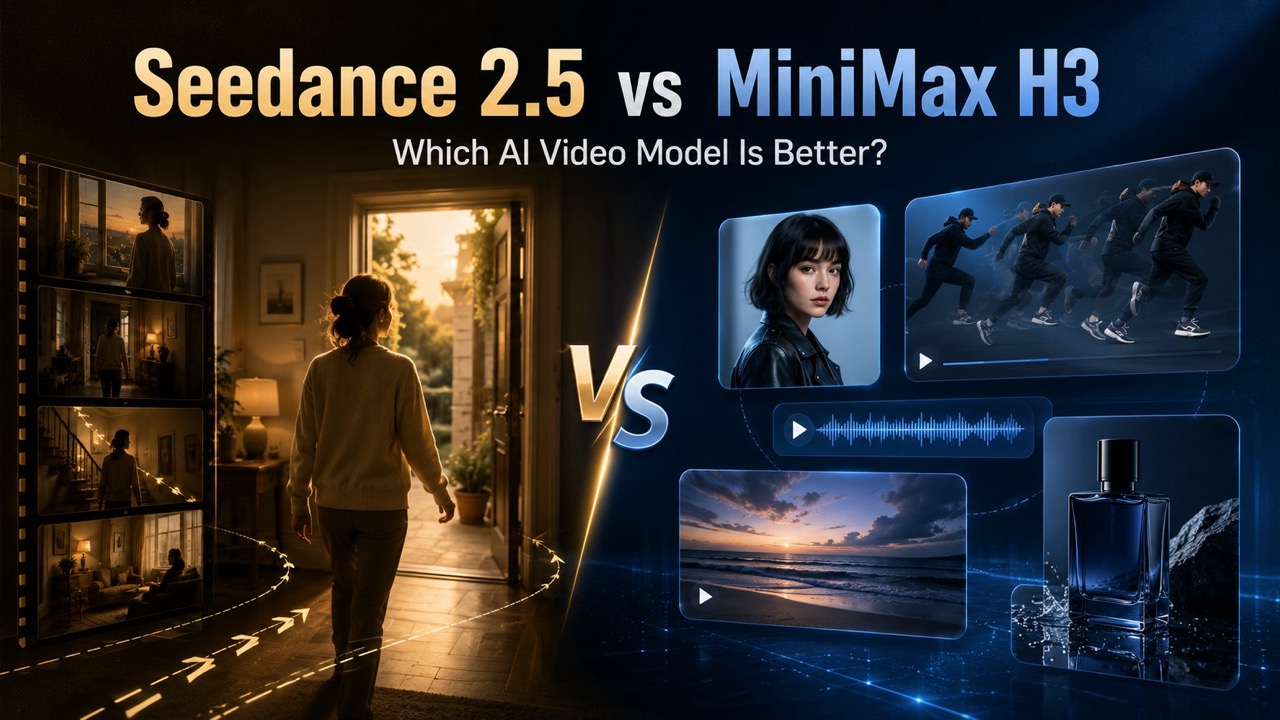
Compare Seedance 2.5 and MiniMax H3 across video length, reference control, motion, editing, audio, and real same-prompt tests. See where each model stands out and which one better fits different AI video workflows.
Seedance 2.5 and MiniMax H3 are both advanced AI video models, but choosing between them is not as simple as comparing resolution, duration, or a feature checklist. Their capabilities overlap in many areas, yet they place emphasis on different parts of the video creation process.
Seedance 2.5 is built around longer storytelling, precise reference control, connected motion, and production-oriented video editing. MiniMax H3 takes a general-purpose multimodal approach, understanding text, images, video, and audio within one creative context.
On paper, Seedance 2.5 offers more room for longer scenes and complex cinematic direction. MiniMax H3 brings its own strengths in unified references, video transformation, motion transfer, 2K output, and native stereo audio.
But specifications only tell part of the story. We also tested both models with the same prompts to see how those differences appear in actual generated videos.
Seedance 2.5 vs MiniMax H3 at a Glance
Here are the differences most likely to affect an actual generation workflow.
| Comparison | Seedance 2.5 | MiniMax H3 |
|---|---|---|
| Prompt input | Text prompts | Text prompts |
| Reference media | Images, videos, and audio | Images, videos, and audio |
| Maximum model-level duration | Up to 30 seconds | Up to 15 seconds |
| Longer storytelling | A core focus | Supported within a shorter duration |
| Reference control | Emphasizes framing, cinematic language, and creative interpretation | Emphasizes unified use of different reference types |
| Video editing | Powerful editing capabilities | Reference-based creation and video editing |
| Motion reference | Can interpret motion as part of wider cinematic direction | V2V motion transfer is a highlighted capability |
| Audio | Audio-video joint generation | Native stereo sound |
| Resolution | Depends on the available deployment and settings | Up to 2K at the model level |
| Particularly relevant for | Longer scenes, connected action, cinematic direction | Mixed references, transformation, editing, and short-form workflows |
Both models can therefore start from a text prompt or incorporate additional reference media. The bigger difference is not whether they accept multimodal inputs, but how those capabilities can be used within a workflow.
Where Seedance 2.5 Stands Out
1. More Room for Longer Sequences
Seedance 2.5 supports videos up to 30 seconds at the model level. That extra time becomes relevant when a scene contains several actions, reactions, or camera changes rather than one isolated movement.
A longer generation window does not automatically guarantee better prompt adherence, but it gives a sequence more space to establish an action, develop it, and reach a natural ending.
2. Reference Control Goes Beyond Motion Copying
Seedance 2.5 is designed to interpret more than the visible movement inside a reference video. It can also use information such as framing, cinematic language, camera direction, and performance blocking.
That makes the Seedance 2.5 AI Video Generator particularly interesting when a reference is intended to guide how a scene is staged and filmed, not only how a subject moves.
3. Camera and Performance Direction Matter
Professional camera movement and performance blocking are also part of Seedance 2.5's feature set. These controls can be useful for prompts involving changing perspectives, coordinated subject movement, or scenes that need a more deliberately directed structure.
Where MiniMax H3 Stands Out
1. Different References Can Play Different Roles
MiniMax H3 understands text, images, video, and audio within one unified context.
A creator can use an image to define a character while another video provides motion or camera behavior. The prompt can explain what each reference is expected to contribute rather than treating every uploaded asset as generic inspiration.
That makes MiniMax H3 useful for workflows built around several different source materials.
2. Video Transformation Is an Important Use Case
H3 supports reference-based creation, editing, and V2V motion transfer. These capabilities become relevant when useful movement or structure already exists in another video and the goal is to reinterpret it with a different character, environment, or visual direction.
3. Short Audiovisual Work Has Its Own Advantages
H3 can generate clips up to 15 seconds at up to 2K resolution with native stereo sound.
For product shots, short advertisements, social clips, animated posters, and other tightly defined videos, those characteristics may matter more than having a longer maximum timeline.
The MiniMax H3 AI Video Generator is therefore not simply a shorter alternative to Seedance 2.5. Its multimodal and transformation-oriented capabilities support a different set of workflows.
Same Prompt, Two Models: What Changed?
Feature descriptions explain what a model is designed to do, but they cannot show exactly how two models will interpret the same instruction.
To make this comparison more practical, we generated two prompts with both Seedance 2.5 and MiniMax H3.
Within each test, we kept the prompt and video duration the same. Available output resolutions differed between the two models, so the observations below focus on prompt following, motion, continuity, camera behavior, and object consistency rather than sharpness alone.
Test 1: Following a Multi-Step Action Sequence
Prompt:
A man returns home carrying two grocery bags. He places them on the kitchen counter, notices an orange rolling out of one bag, stops it with his foot, picks it up, and puts it back on the counter. Natural indoor lighting, realistic movement, steady medium-wide camera.
Seedance 2.5 Result
MiniMax H3 Result
What We Noticed
Both models clearly show the man carrying two grocery bags and establish the basic setup of the scene correctly.
The main weakness appears when the orange enters the action. In both videos, the orange does not convincingly roll out of one of the grocery bags as described in the prompt. Instead, it seems to appear suddenly before dropping or moving toward the floor, which makes the transition feel physically unnatural.
After the orange appears, the Seedance 2.5 result makes the following action somewhat easier to read. The wider framing keeps the man, the orange, and the floor visible together as he bends down to retrieve it.
MiniMax H3 also completes the main action sequence, but the requested moment of stopping the orange with his foot is less distinct, and the tighter framing makes that interaction slightly harder to follow.
The clearest shared weakness is the physical continuity of the orange. Both models understand that an orange should leave the bag, fall, and then be picked up, but neither shows a fully convincing transition from the orange being inside the bag to appearing naturally in the scene.
Despite that shared issue, Seedance 2.5 delivers the stronger overall result in this test. Its wider framing makes the sequence easier to follow, and the interaction between the man, the orange, and the floor remains clearer once the orange appears. MiniMax H3 completes the main action as well, but the tighter framing and less distinct foot-stop moment make parts of the sequence harder to read.
Test 2: Camera Movement and Object Consistency
Prompt:
A pair of running shoes sits beside an open gym bag on a wooden bench. The camera slowly moves from left to right, then pushes closer to the shoes as sunlight shifts across the floor. Keep the shoes, bag, bench, and surrounding objects consistent throughout the shot. Natural late-afternoon lighting.
Seedance 2.5 Result
MiniMax H3 Result
What We Noticed
Both models keep the running shoes, gym bag, and bench recognizable throughout the sequence, without major object changes disrupting the shot.
Seedance 2.5 produces a more noticeable push toward the shoes, making the camera approach a stronger part of the composition.
MiniMax H3 uses a subtler camera move, while the changing sunlight across the floor is particularly visible. The main objects also remain stable as the shot develops.
This test does not produce a simple winner. Instead, the models emphasize different parts of the same instruction: Seedance 2.5 makes the camera approach more pronounced, while MiniMax H3 makes the lighting change easier to notice.
Two generations are not enough to establish that either model will behave the same way across every prompt. They do, however, show why testing the same creative brief can reveal differences that a specification table cannot.
Should You Prompt Seedance 2.5 and MiniMax H3 Differently?
Both models can understand detailed natural-language instructions, so there is no need to use completely different prompting systems.
However, their feature sets suggest slightly different ways to organize information when a prompt becomes more complex.
Prompting Seedance 2.5
For a scene with several actions, it can be useful to make the sequence and subject count explicit.
For example:
A father carries one sleeping child in his arms from the car toward the front door. Only one adult and one child are present in the scene. He opens the door with one hand, pauses when the child shifts slightly, then quietly walks inside. Slow handheld follow shot, warm porch lighting, natural body movement, calm nighttime atmosphere.
This prompt identifies:
- exactly who is present;
- what happens first;
- what happens next;
- how the camera should move;
- and what kind of pacing and atmosphere the scene should maintain.
Explicit details such as "one sleeping child" are useful when subject count matters. A looser phrase such as "his sleeping child" may still be understood correctly, but generative models can occasionally introduce additional subjects that were not requested.
Prompting MiniMax H3 With Multiple References
H3 becomes especially interesting when different references are assigned different jobs.
For this example, Image 1 defines the character while Video 1 provides the walking motion and camera behavior.
Image 1: Character reference image.
Video 1: A person walking steadily while the camera follows with gentle handheld movement.
Reference video prompt:
A person walks steadily along a quiet sidewalk at night while the camera follows from the front with gentle handheld movement. Natural walking pace, subtle body motion, slight camera sway, continuous forward tracking shot, realistic movement, no cuts.
Once those assets are prepared, the H3 generation prompt can state clearly how they should be used:
Use Image 1 for the character's appearance. Follow the walking motion and handheld camera movement from Video 1. Keep the character's clothing and facial features consistent while changing the setting to a quiet residential street at night.
The important part is not the exact wording. It is the relationship between the references.
Instead of simply uploading several files and hoping the model infers their purpose, the prompt tells H3 which source controls identity and which one provides motion and camera direction.
Seedance 2.5 can also work with multimodal references, so this should not be read as an H3-only prompting technique. It is simply a particularly useful way to take advantage of H3's unified multimodal context.
Seedance 2.5 vs MiniMax H3: What Should You Choose?
There is no need to force every video task into one universal model recommendation.
Seedance 2.5 deserves particular consideration when:
- the scene needs more time to develop;
- several actions or reactions need to remain connected;
- camera direction and performance blocking are important;
- a reference video should influence framing or wider cinematic behavior;
- the project benefits from a longer model-level generation window.
MiniMax H3 deserves particular consideration when:
- several reference assets need to contribute different information;
- motion transfer or video transformation is central to the workflow;
- you want to edit or reinterpret existing video material;
- the final result is a relatively short audiovisual clip;
- native stereo sound or up to 2K model-level output is useful for the project.
There are also many prompts where both models are reasonable options.
Our two side-by-side tests illustrate that overlap. Seedance 2.5 made the multi-step action in the first test easier to follow and produced a more noticeable camera push in the second. MiniMax H3 still completed the main action sequence, maintained the key objects in the second test, and made the requested lighting change particularly visible.
Those observations apply to these specific generations. They should not be treated as proof that the same model will outperform the other on every similar prompt.
Final Verdict: Compare the Model to the Task
Seedance 2.5 and MiniMax H3 operate at a level where a simple "winner" does not explain the most useful differences between them.
Seedance 2.5 offers a longer generation window and places substantial emphasis on storytelling, reference interpretation, camera direction, motion continuity, performance blocking, and editing. These capabilities make it particularly relevant when the complexity comes from how a scene develops over time.
MiniMax H3 combines text, image, video, and audio information within a unified context while supporting reference creation, video editing, V2V motion transfer, native stereo sound, and output up to 2K. These capabilities become especially relevant when the challenge is coordinating or transforming different source materials.
Our own tests also show why the comparison should remain practical rather than absolute. Seedance 2.5 interpreted some requested actions and camera movement more explicitly, while MiniMax H3 remained competitive in continuity and captured other details of the same prompts effectively.
The most useful way to choose between Seedance 2.5 and MiniMax H3 is therefore to identify the hardest part of the video you want to create, then choose the model whose capabilities best address that requirement.